
Friday, September 11, 2015
Framing

Balance

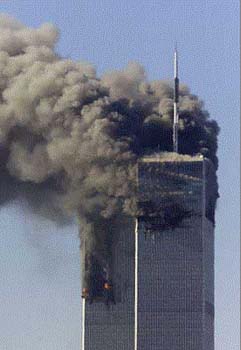
This picture shows vertical balance as shown though the amount of damage on either side of the picture is equal. This also shows horizontal balance as the falling debris balances out the smog of the air.
Lines

Rule of Thirds

Simplicity
Wednesday, September 9, 2015
The Camera
The camera obscura, Latin for dark room, is an optical effect. The effect is achieved like this: inside pitch black room, a tiny hole is made on one wall. Through this hole, light is focused and the scene on the other side of the hold is projected upside down on the wall inside the room.
In the 17th century, Isaac Newton and Christian Huygens completed the understanding of optics and the process making high quality lenses for glasses.
In 1827, Joseph Niepce invented an important part of the first modern camera, the film.
Modern digital cameras work somewhat similarly to Niepce's camera. Much like the first modern camera, light enters the lens and exposes the film, resulting in a photograph.
Digital cameras have replaced the old-fashioned plastic film of the past and capture images with an electronic sensor called a CCD, the photographs are then stored on a reusable computer memory device.
The difference between the auto and program modes is that the auto mode controls flash and exposure, and the program mode allows the photographer to control flash and some other settings.
Portrait mode is used to blur out the background, the camera achieves this by using the fastest available lens setting.
Sports mode is used to capture a moving object by using the highest shutter speed possible.
A photographer should half-press the button in order to allow the camera some extra time to focus.
The disabled flash symbol, used when flash isn't needed, is a zig-zag arrow surrounded by a circle with a line though it.
The auto flash symbol, when the camera uses the amount of flash it deems necessary, is a zig-zag arrow with the word auto next to it.
If a photo has too much light, the picture is washed out.
If a photo has too little light, the picture is too dark to see.
A stop is a term used to represent a change in the brightness of a light.
If two suns are used, instead of one, then the stop is +1 Stop.
If four suns are used, instead of two, then the stop is +2 Stops.
The longer shutter speeds mean that more light enters the camera.
The shorter shutter speeds mean that less light enters the camera.
The aperture controls how big the opening is that allows light to enter the camera.
When adjusting the aperture, the smaller the F-Stop number is, the larger the opening.
Black and White Photographs from the Past
Alexander Rodchenko: The poet Vladimir Mayakovsky, 1924


Carleton Watkins: Coast View Number One, 1863

Alvin Landon Coburn: W. B. Yeats, 1908

Subscribe to:
Posts (Atom)