My favorite photo is the picture of the math teacher using an old projector to teach her student. I picked this photo because it is the most reverent to my life and it shows how far technology has come since the image was taken. Some of the rules of photography that are evident in the photo are rule of thirds and lines.
I could take similar pictures by photographing during brain breaks that some teachers take, during monologues that theatre students present, and during a lab in a science class. I would like to take pictures in the yearbook room, the theatre room, and during color guard practice. As the photographer, I will get amazing photographs like the ones I viewed today by utilizing all of the angles possible, using different zooms, and following some of the rules of photography.
Friday, September 25, 2015

Filling the Frame

Action and Emotion

The Story

This photograph tells the best story because the image shows a story though the bowing of the students' heads and the fact that all of the students are holding hands around a flagpole. There are several possible stories that could be associated with this image. One possible story is that a fellow student was injured or possibly died in an accident and the student body is praying for the injured student or the deceased student's family and friends. Another possible story is that somebody important to the community died and the student body is praying for the community and the person's family. A third possible story is that this is a religious group that meets before/after school for a religious ceremony.
Wednesday, September 23, 2015
Photo Manipulation and Ethics II


Photo Manipulation and Ethics
There have been many instances of photo manipulation in the Middle East, a serious offense in the United States, however, this crime often goes unpunished in the Middle East . If a newspaper in America were to publish a manipulated photograph, the photographer would be fired and lose credibility as manipulating images is considered unethical because it shows the public untrue images.
Ethics in the age of digital manipulation
In my opinion, photo manipulation is unethical because it shows the public an untrue image and could taint or sway a person's opinion of a topic. However, I believe that small edits are acceptable when the photos will be used for personal use only and when all participants give consent for the editing to take place.
Monday, September 21, 2015
Great Black and White Photographers II
Carleton Watkins was born in 1829 in Oneonta, New York to John and Julia Watkins. In 1851 Watkins moved to San Fransisco during the California Gold Rush. Before working in photographs, Watkins originally delivered supplies to mining operations, was a store clerk at a bookstore. The store at which Watkins worked was near a photography studio belonging to Robert Vance. Watkins was introduced to photography when one of Vance's employees left suddenly, giving the opportunity to look after the studio. After learning the art, Watkins photographed the Pacific coast during the 1860's and 1870's, capturing the landscape in startling ways using stereoscopic and mammoth-plate formats. In 1865 the California State Geological Survey chose Watkins to be the official photographer.
Watkins did not publish any books, however the photographer opened the Yosemite Art Gallery where he displayed several Pacific Coast landscapes. Unfortunately Watkins, a terrible businessman, lost his gallery to J.J. Cook. In 1906, the gallery was lost in the San Francisco earthquake and fire.
Watkins's medical decline began in the 1890's with loss of sight, which lead to the inability to pay rent. In 1909, Watkins was declared incompetent and his daughter cared for him. In 1910, he was committed to the Napa State Hospital for the Insane, and he died in 1916. Watkins's legacy lives on in his stunning pictures of Yosemite.
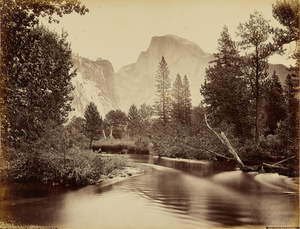
The Half Dome
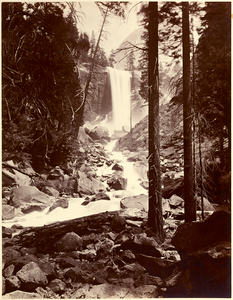
Vernal Fall
Sources:
Subscribe to:
Posts (Atom)